
A “Difficult Breed”…
A friend of mine, who lives in an apartment and has a busy, demanding life, recently got a new dog. Border collie/staffy cross. Within weeks she was frayed at the edges. The dog was naughty and needy. Tearing up the furniture. Clawing at the door frames. Howling when left alone. Growling at other dogs in the park. As frustrating as this was for her, it wasn't rocket science to understand, once you stepped back. A working dog, bred over generations for stimulation and purpose and space, dropped into eleven square metres and a ten-hour workday. The dog wasn't broken. The fit was.
When I was a kid I read through the dog breed encyclopaedias obsessively. The dense, heavy ones, with temperament charts and breed histories and paragraphs on what each dog was originally bred to do. I had favourites, sure, but mostly I just loved how different they all were. A greyhound and a border collie and a bulldog are barely the same species in temperament, and nobody thinks less of the greyhound for needing opportunities to sprint, or the bulldog for needing to nap. We just accept, without much argument, that different dogs need different things, and that a dog struggling in the wrong home isn't a referendum on the dog.
We've never been that generous with each other.
Some of our attempts to categorise human beings have done real damage — the kind that costs lives. Racial categorisation was built to justify ownership of people. Eugenics dressed itself up as biology and used it to decide who was fit to reproduce, and who wasn't fit to live. These aren't cautionary footnotes about "our complicated history with categories." They're closer to the reason categorisation earns suspicion at all.
Then there's a second, much lower-stakes tradition, running almost in parallel: astrology, Myers-Briggs, every quiz that sorts you into a house or a spirit animal or a kind of cheese (I’m Buffalo Mozzarella). Nobody's rounding anyone up over their star sign. But the impulse is recognisably the same one — what kind of creature am I, and who else is like me? just without the machinery to hurt anyone. It's worth being honest about that shared root instead of pretending these sit on the same shelf. They don't. One tradition used categorisation as a weapon. The other uses it mostly as a party trick, or a coping mechanism, or a way of forgiving yourself for dating a Scorpio.
Somewhere between those two, closer to the honest end, sits the Big Five. It's not a personality test in the astrology sense — it's the closest thing psychology has to a stable, cross-culturally replicated measure of trait variation, and it doesn't sort you into a type so much as it plots you on five continuous dimensions: how much novelty you need versus how much stability steadies you, how much solitude restores you versus how much you're fed by other people, how conscientious, how agreeable, how prone to emotional weather. It isn't destiny. But it's a genuinely useful admission that people differ in their baseline needs, in ways that are measurable, fairly stable across a lifetime, and not particularly negotiable through willpower.
And then there's the more recent, more contested territory — the neurodivergent conditions. ADHD, autism, and the rest are still, undeniably, categories: a line drawn on a spectrum, a threshold crossed, a label applied. That's worth sitting with rather than glossing over, because a diagnosis carries different weight than a trait score does — it comes with a system attached, a history of pathologising, sometimes a lifetime of being told you're the dog tearing up the furniture rather than the dog in the wrong apartment.
But something has shifted, at least in the rooms I move in: less "how do we fix this person" and more "what environment, what accommodations, what kind of care does this particular nervous system actually need." That's the same move dog breeders have been making for a century. Nobody accommodates a border collie by telling it to want less.
I want to be honest about where this argument gets convenient for me, because I can feel it getting convenient. It would be very easy to reach for "difficult breed" the way people reach for any label that lets them stop looking at themselves — a tidy diagnosis that explains the mess without implicating the person making it. That's not nothing. Some of what gets called neediness is a trait. Some of it is a wound doing an impression of a trait, and no amount of "right fit" fixes a wound; it just finds a partner patient enough not to notice it isn't healing. I don't think I get to skip that distinction just because the metaphor is flattering.
But here's what I've landed on anyway, holding both things. Being back in the dating scene, when I felt too needy, my instinct was to put the fault back on myself — to believe I needed to shrink, adapt, want less, want it more quietly. And some of that instinct was probably right; not every discomfort in a relationship is a fit problem. But some of it wasn't fault at all. I am, by most honest measures, high in the traits that make people call you "a lot" — I need a certain density of attention, a certain kind of emotional presence, a partner who isn't just tolerating the need but genuinely built to meet it. That's not a flaw needing correction so much as a temperament needing the right household. I'm not less-than for needing more, or more particular, care. I just require the kind of attention only a specific, dedicated few are actually equipped to give, and the rest of the world isn't obligated to become that, any more than an apartment is obligated to become a farm.
Whether that's self-knowledge or self-justification, I genuinely don't know yet. Possibly both, depending on the day. I suspect the honest answer changes depending on who's asking, and how tired I am, and whether the last person who considered me "a lot" was right.
But maybe that's what adulthood is. Spending less time asking whether you're too much, and more time asking whether you've simply been trying to become the wrong kind of dog.
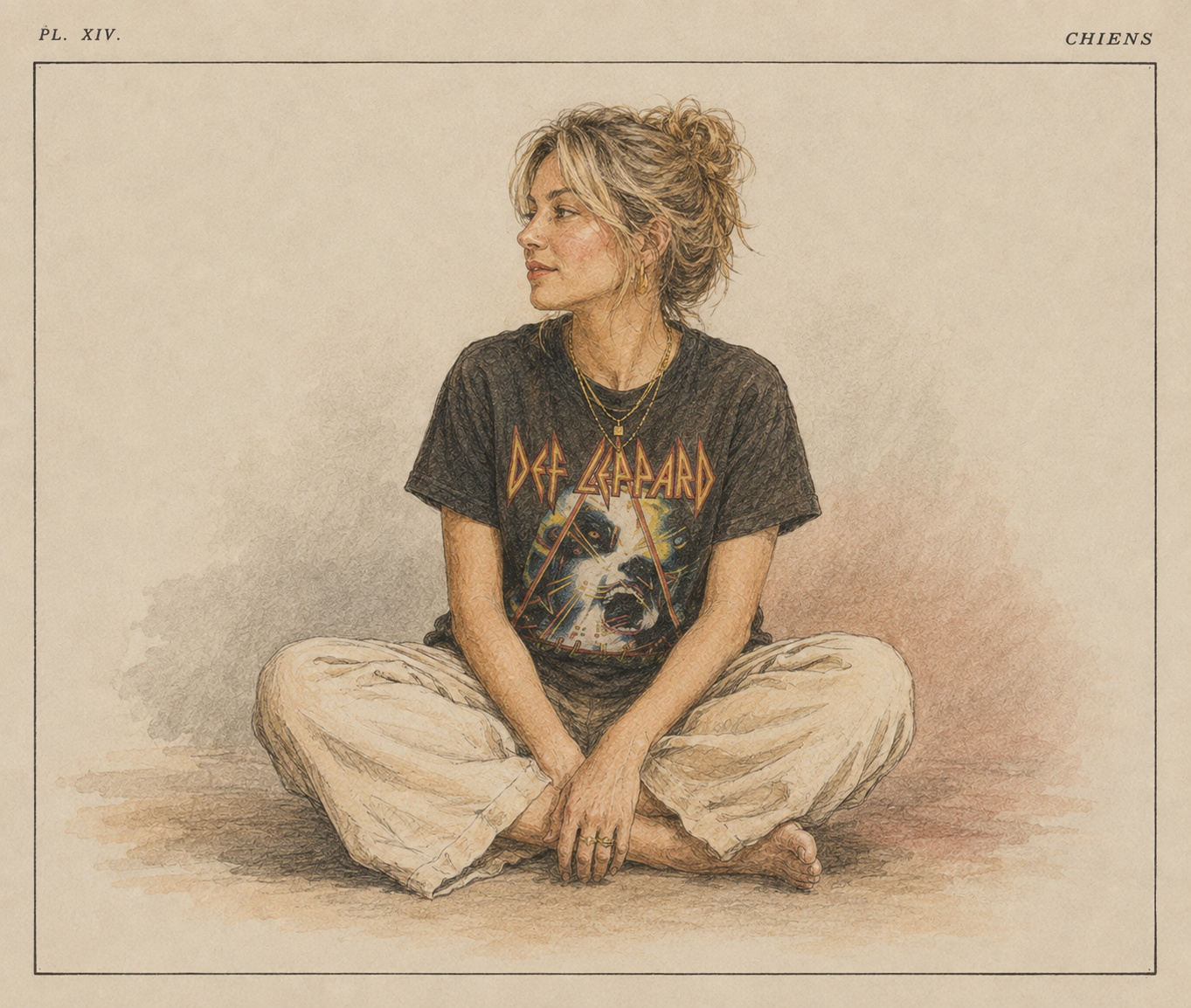
Psychologue australien (F.)
Height: Compact.
Coat: Blonde, occasionally windswept.
Temperament: Curious, observant, affectionate, mildly sarcastic.
Exercise: Moderate to vigorous. Incline treadmill preferred.
Enrichment: Literature, psychology, rock music, galleries, and asking "But what does that say about us?"
Suitable for: Creative households able to provide intellectual stimulation and occasional wine.
Caution: May attempt to psychoanalyse visitors. Benefits greatly from regular pats, thoughtful conversation, and oversized vintage band t-shirts